Molecular Dynamics Simulation (Online Hands-on Workshop)
This workshop equips participants with practical skills to perform, analyze, and interpret molecular dynamics simulations using industry-standard tools.
29 JULY TO 01 AUGUST 2026 | 6:30 PM IST | ONLINE
29 July to 01 August | 6:30 PM IST | Online Hands-on Workshop | Certificate
About the Workshop
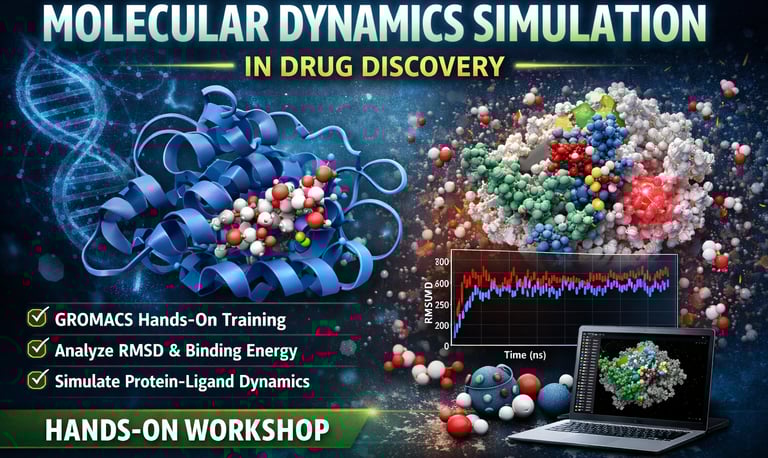
This online hands-on workshop provides a comprehensive understanding of molecular dynamics (MD) simulations and their applications in drug discovery. Participants will learn how to set up simulations, run them using GROMACS, and analyze results to study protein–ligand interactions and stability.
What You Will Learn
Fundamentals of molecular dynamics simulation
Setting up protein–ligand systems
Simulation parameters (force fields, solvation, temperature, pressure)
Running MD simulations using GROMACS
Energy minimization and equilibration
Trajectory analysis (RMSD, RMSF)
Binding free energy calculations
Visualization using PyMOL
Course Features
Live hands-on workshop sessions
e-Certificate upon completion
Session recordings for revision
Software installation support
Protocols and lecture PPTs provided
Learning Outcomes
Set up and execute MD simulations independently
Analyze protein–ligand interactions over time
Interpret simulation outputs and trajectories
Apply MD techniques in drug discovery research
Use computational tools for advanced bioinformatics studies
Who Can Join
Undergraduate and postgraduate students in Life Sciences
Research scholars and faculty members
Professionals in Biotechnology, Bioinformatics, and Pharmaceutical sciences
Medical, Pharmacy, and Chemical Sciences background
Course Fee
Indian Participants: 1400 INR
International Participants: 75 USD
Workshop ModuleDay 1: Introduction to Molecular Dynamics (MD) Simulation
Basics of molecular dynamics and its relevance to drug discovery
Setting up MD simulations for protein–ligand complexes
Simulation parameters: force fields, solvation models, temperature, pressure, and time steps
Hands-on: Using GROMACS to set up a basic MD simulation
Day 2 & 3: Running MD Simulation
Understanding solvation, ionization, energy minimization, equilibration, and production MD run
Hands-on: Executing a simulation for a specific protein–ligand complex using GROMACS
Day 4: Analyzing MD Simulation Results
Extracting and interpreting MD trajectories: RMSD, RMSF, and binding free energy calculations
Stability assessment of protein–ligand interactions over time
Generating and visualizing dynamic trajectories
Hands-on: Using PyMOL to analyze MD results